
Version 1.5 of Smarter Event Booking is currently being validated by Microsoft and will be available in the Microsoft Marketplace shortly. Until then the Marketplace installs the previous version; the update follows through the app catalog.
Getting Started with Smarter Event Booking
From installation to the first registration: how to create events, generate series and time slots, manage registrations and export participant lists.
Table of contents
Installing the app
Installation runs in two steps: first in the tenant app catalog, then on the site where you want to use it.
1. Add the app to the app catalog
Get Smarter Event Booking from Microsoft AppSource and add it to your tenant’s app catalog. Deployment requires tenant administrator rights.
Related guide
2. Add the app to your site
Then add the app to the site via “Add an app”. The license applies per site collection; for several sites there are plans for up to five and for all site collections in a tenant.
The first visit needs permissions
The first time it is opened, the app creates its SharePoint lists and their columns itself. Whoever opens the web part first needs the “Manage lists” permission – usually a site owner. The same applies after an update that adds a new column.
3. Approving the Microsoft Graph permissions
Three features reach into Microsoft Graph. They need an administrator's approval in theSharePoint Admin Center → Advanced → API access.
Mail.Send
The confirmation emails to participants. Without approval, no mail goes out.
Calendars.Read
The “Show my calendar” button in the calendar view.
User.Read.All
Additional profile fields in the participant export. Without approval those columns stay empty; the export still runs.
The app checks this itself
The configuration holds two tests under Email: “Mail.Send permission test” sends a test message to you, and “Calendars.Read permission test” reaches into your own calendar. Both say plainly whether the approval is missing — which saves guessing when no mail arrives.
Licence
On first start the app creates a 14-day trial licence. After that the site collection needs a licence from AppSource. The current state is shown in the configuration underGeneral → License information; it is cached for up to 24 hours.
Adding the web part to a page
Edit a SharePoint page and add the web part you need. The solution ships two of them.
Smarter Event Booking
The main web part for management: create events, maintain dates, and see registrations and participants.
Overview
A lightweight second web part for home pages: it lists upcoming dates, across several sites if you want, as a list or a carousel.
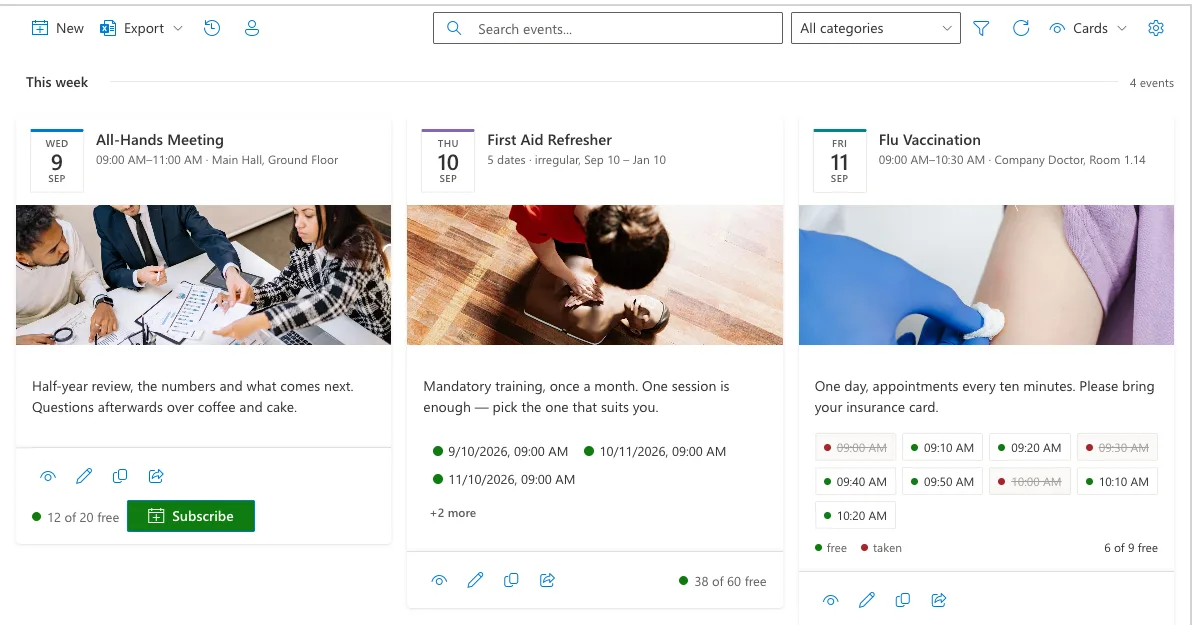
Four views
The toolbar switches between cards, calendar, list and the classic view. Which one appears on open is set in the configuration.
Creating your first event
“New” opens a form with two columns. The event and its first date are created together – an event without a date does not exist.
Left: the event
Title, description and – collapsed until you need them – image, category and colour, your own questions at registration, and the confirmation email with attachments.
Right: the date
Date, time, location and seats. Under “More” you find the registration and deregistration deadlines and the limit per person.
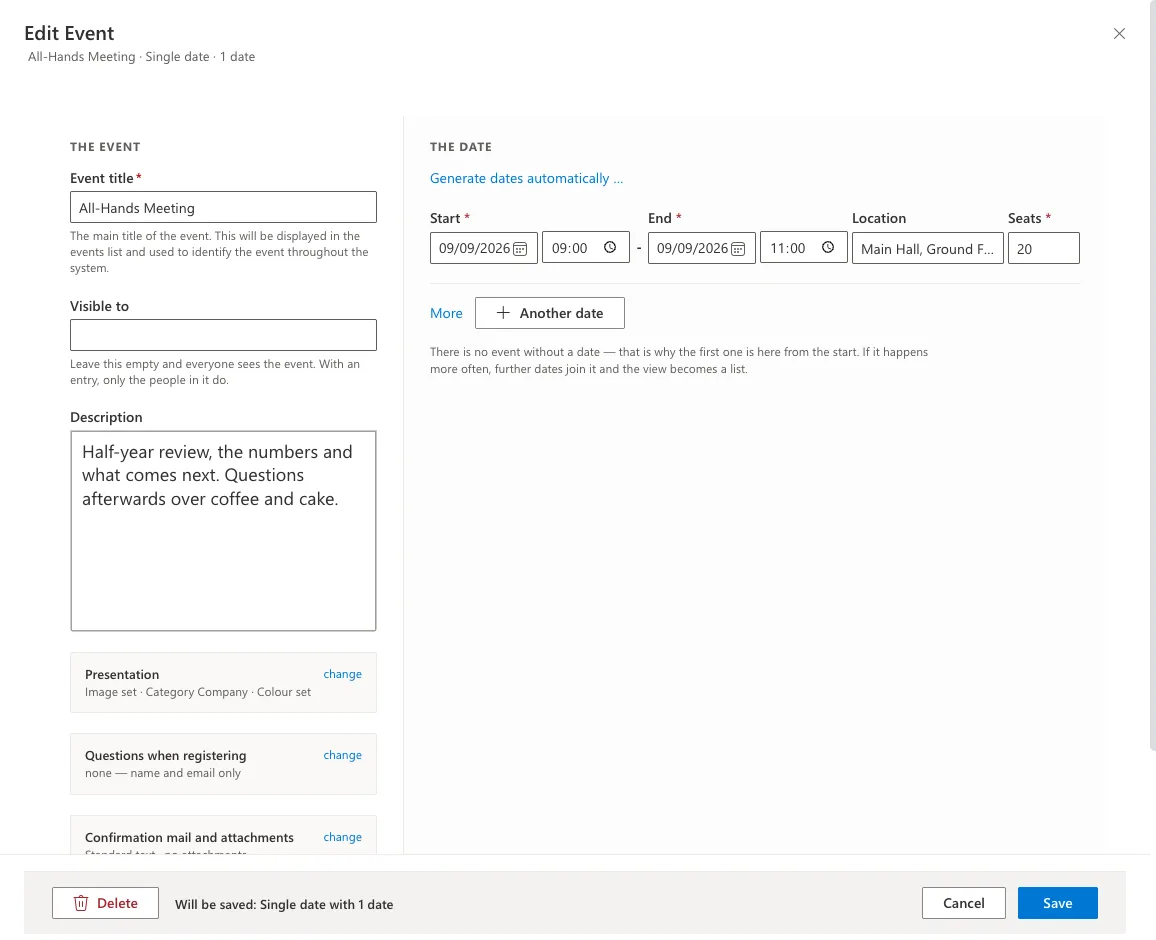
Delete sits in the same dialog
“Delete” is at the bottom left. The confirmation states what goes with it – dates and registrations included.
Series, multi-date events and time slots
When an event happens more than once, you do not have to type every date.
Generate dates automatically
Give a rhythm and an end date – daily, weekly, monthly or yearly. The dates are created in one go.
Another date
Add irregular dates one by one. From the second date on, the input turns into a list.
Time slots
Split a day into slots of equal length, for example 48 ten-minute slots. Each slot carries its own number of seats.
Visible to
Leave the field empty and everyone sees the event. Enter people or groups and only they see it.
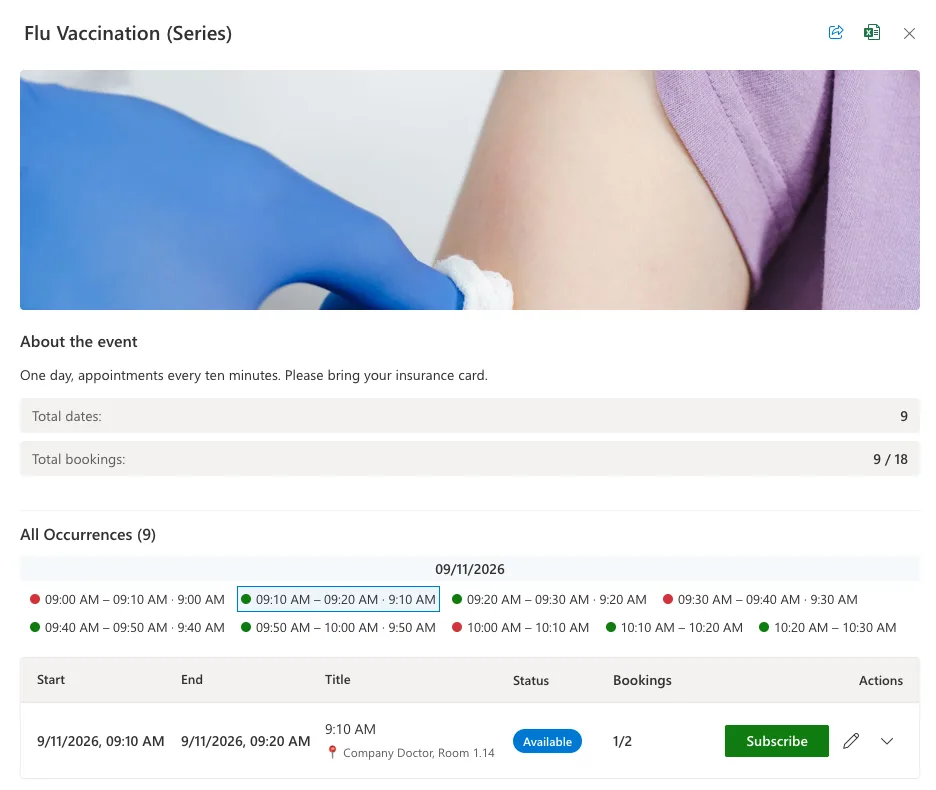
What time slots are for
Vaccination days, performance reviews, fittings, advisory appointments: anywhere many people come in one after another and nobody should have to wait.
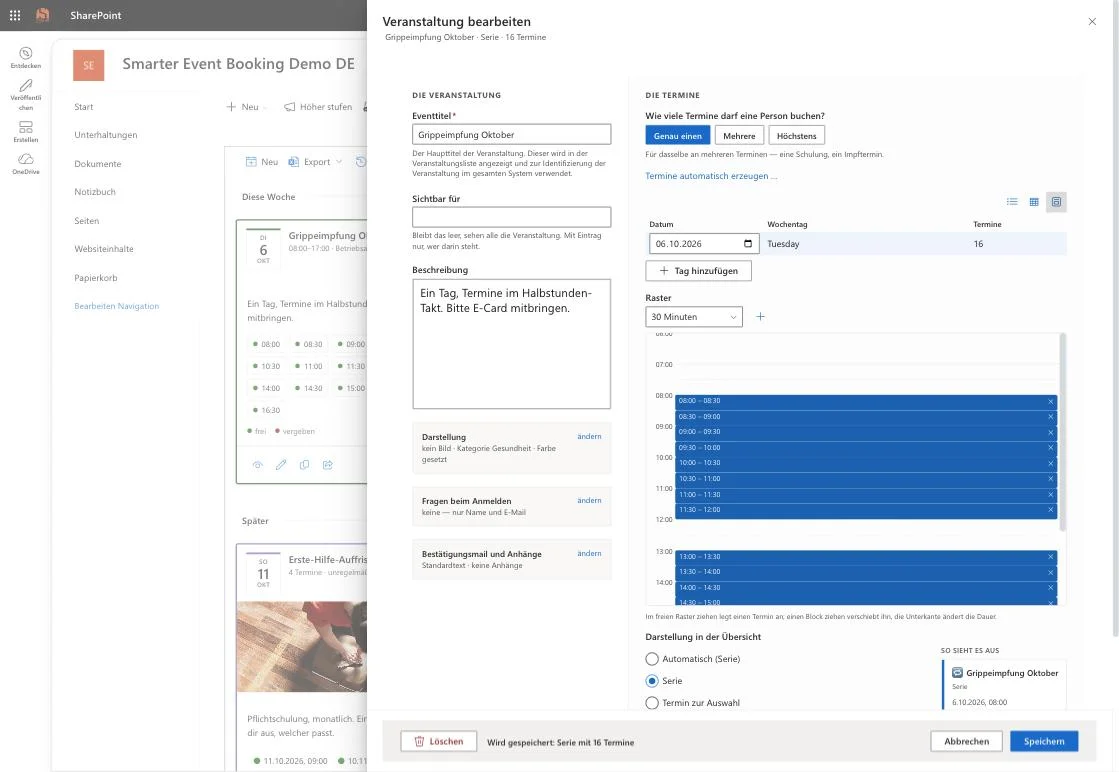
Editing dates: table and day schedule
When an event has several dates, the form offers three views above the list of dates:List, Table and Day schedule.
List
The familiar way: each date with all its fields, including deadlines, description and its own confirmation email.
Table
All dates of one day as rows. The pencil in a column header sets title, location or seats for all of them at once (“Apply to all”).
Day schedule
The dates as blocks on a time axis: drag on free space to create a date, move a block, drag its bottom edge to change the duration. “Snap” aligns to 5 to 60 minutes.
Table of days
Above table and day schedule: changing a date moves the whole day with its times; “Add day” repeats the same schedule on the next free day.
Moving dates that have registrations
When a date that already has registrations gets a new time, saving asks first: “Move dates that have registrations?” – with the old and new time and the number of registrations. Those registered are not notified automatically; that is what “Message all attendees of the event” is for.
Registrations and waiting list
People always register for a single date. The card states how many seats are still free.
Seats available
People register straight from the card. The confirmation follows immediately – with a calendar file attached or as an Outlook invitation.
Date full
With the waiting list enabled, people join it and move up as soon as a seat frees up.
Your own questions
A registration form collects additional details, such as a meal preference or a department.
Companions
Where allowed, participants bring companions along. They count towards the seats.
The confirmation email
A template can sit in two places: on the event and on the individual date. The date's template wins. If neither is set, no mail goes out. On top of that, “Enable email notifications” has to be on in the configuration under Email — the same tab states underneath what is actually being sent right now.
These placeholders are filled in when the mail is sent:
[EventTitle]– title of the event[DateTitle]– title of the date[DateStart],[DateEnd]– start and end[DateLocation]– location[DateSubscribeUntil],[DateUnsubscribeUntil]– registration and cancellation deadlines[Ics]– the calendar entry to take into Outlook
Formatting carries over
The template has a rich-text editor. Formatted text from Word can be pasted in and keeps its look. Information material goes on the event as a file attachment and travels with the confirmation.
Outlook invitation from a shared mailbox
Instead of a calendar file attached, the confirmation can arrive as a real meeting request: people accept it like any other meeting, it sits in their personal calendar, and unsubscribing sends a cancellation that removes it again. Sender and organiser is a shared mailbox, which also receives the responses.
1. Create a shared mailbox
In the Microsoft 365 admin center under “Teams & groups → Shared mailboxes”, for example events@yourcompany.com. A shared mailbox needs no licence of its own.
2. Grant “Send As”
Confirmations are sent by the browser of the person who registers – in the name of the mailbox. Everyone who registers therefore needs “Send As” on the mailbox; the easiest way is a group that contains all employees.
3. Keep copies in the mailbox
On the mailbox, under “Sent items → Edit”, switch on both options. All confirmations and invitations then also appear in the mailbox’s sent items.
4. Configure Event Booking
Configuration → Email: test Mail.Send, enter the “Shared Mailbox Email Address”, and under “Calendar entry in the confirmation” choose “As an invitation from the shared mailbox”.
The invitation is the confirmation
In invitation mode there is no additional confirmation email. Outlook often processes meeting requests by itself and puts the appointment straight into the calendar – then nothing stays in the inbox. The cancellation on unsubscribe, by contrast, stays visible.
“Send As”, not “Send on Behalf”
With “Send on Behalf” the invitations still arrive, but Exchange treats them as a forwarded meeting and drops a “Meeting Forward Notification” into the shared mailbox for every registration. With “Send As” there are none.
Times in the right time zone
Under Email → “Time zone for dates and times in e-mails” the default is “Time zone of the site (recommended)”. Colleagues abroad then read the time the event actually takes place.
Participants and export
Clicking an event opens the detail panel with all of its dates and where each one stands.
See participants
The detail panel shows where each date stands. Whether participants can see one another is a setting in the configuration.
Export to Excel
Download participant lists as an Excel file, including the answers from the registration form and selected profile fields.
Message everyone
“Message all attendees of the event”, next to the export, reaches those registered for any of its dates – each person once, waiting lists excluded.
Past events
A separate area in the toolbar lists events that have happened, one row per event. “Show details and attendees” opens it like a current one, plus “Hold again (create a copy)” and “Edit and put online again”.
Editing through the lists
For bulk changes, the configuration links straight into the SharePoint lists, where the usual list features apply: filtering, sorting and quick edit.
Showing dates on your home page
The solution's second web part is called Smarter Event Booking Overview. It manages nothing; it lists the next dates — from several Event Booking pages at once if you want — and links into the event itself. That makes it fit an intranet home page without putting the whole management view there.
Setting it up
Edit the page, add the Smarter Event Booking Overview web part, then open the property pane on the right. Four settings are all it takes.
Event Booking pages
One page per line — each a page carrying the main web part. A display name can go in front: “North Works | https://…/SitePages/EventBooking.aspx”.
Display
“Overview – list and calendar” is the default. “Carousel – the next events as cards” is the variant for a home page; below it you set the optional auto-advance.
Maximum number of displayed items
Caps how many dates are loaded across all sources.
Show only open events
Hides dates that can no longer be registered for.
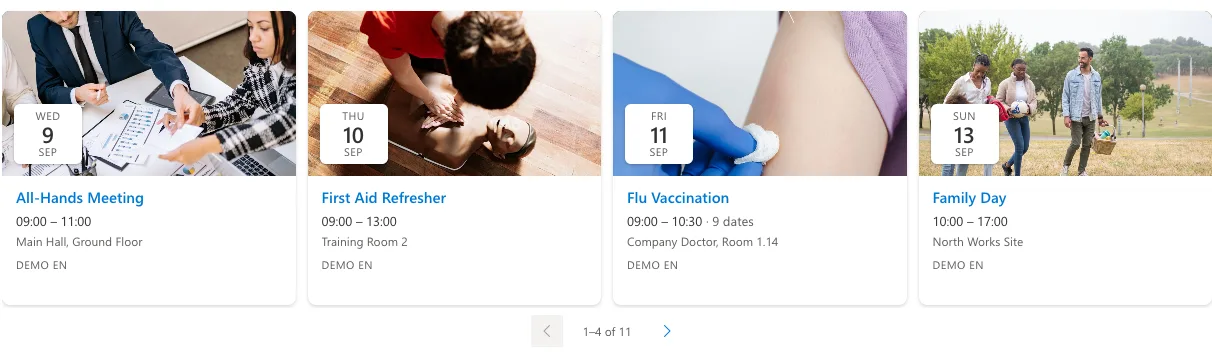
How the carousel behaves
The row goes by its own width, not the window's: in a narrow column at the side of the page, or on a phone, it shows exactly one card; in a wide zone as many whole cards as fit — never a clipped one. Page through it with the arrows underneath, the mouse wheel, a finger or the arrow keys. If you like, the row advances on its own (“Carousel advances on its own”, in seconds); it pauses while the mouse is over it and has a pause button.
Bringing several sites together
Enter more than one Event Booking page and the web part collects their dates into one row. From the second source on, a Site filter appears with an “All sites” entry.
Configuration
The gear icon in the toolbar opens the configuration, split into tabs.
General
Waiting list, visibility of participants, categories, default view, “Colour frame around the whole card”, “All cards the same height”, sorting, and the profile fields used for the export.
Permissions
Who may create and edit events, and who only registers.
Buttons
Which actions appear on the cards.
Templates for the confirmation email, the shared mailbox, whether the calendar entry arrives as a file or as an Outlook invitation, and the time zone for times in emails.
Who sees the configuration
The configuration is open only to people listed as administrators under permissions. Everyone else sees the events and registers.
Frequently asked questions
The first time I open it, an error mentions missing columns. What now?
Why are past events not shown?
How does the waiting list work?
Do dates end up in the Outlook calendar?
Can an event have several dates?
How do I delete an event?
Questions about this product?
Our support team is happy to help with any questions about Smarter Event Booking.